

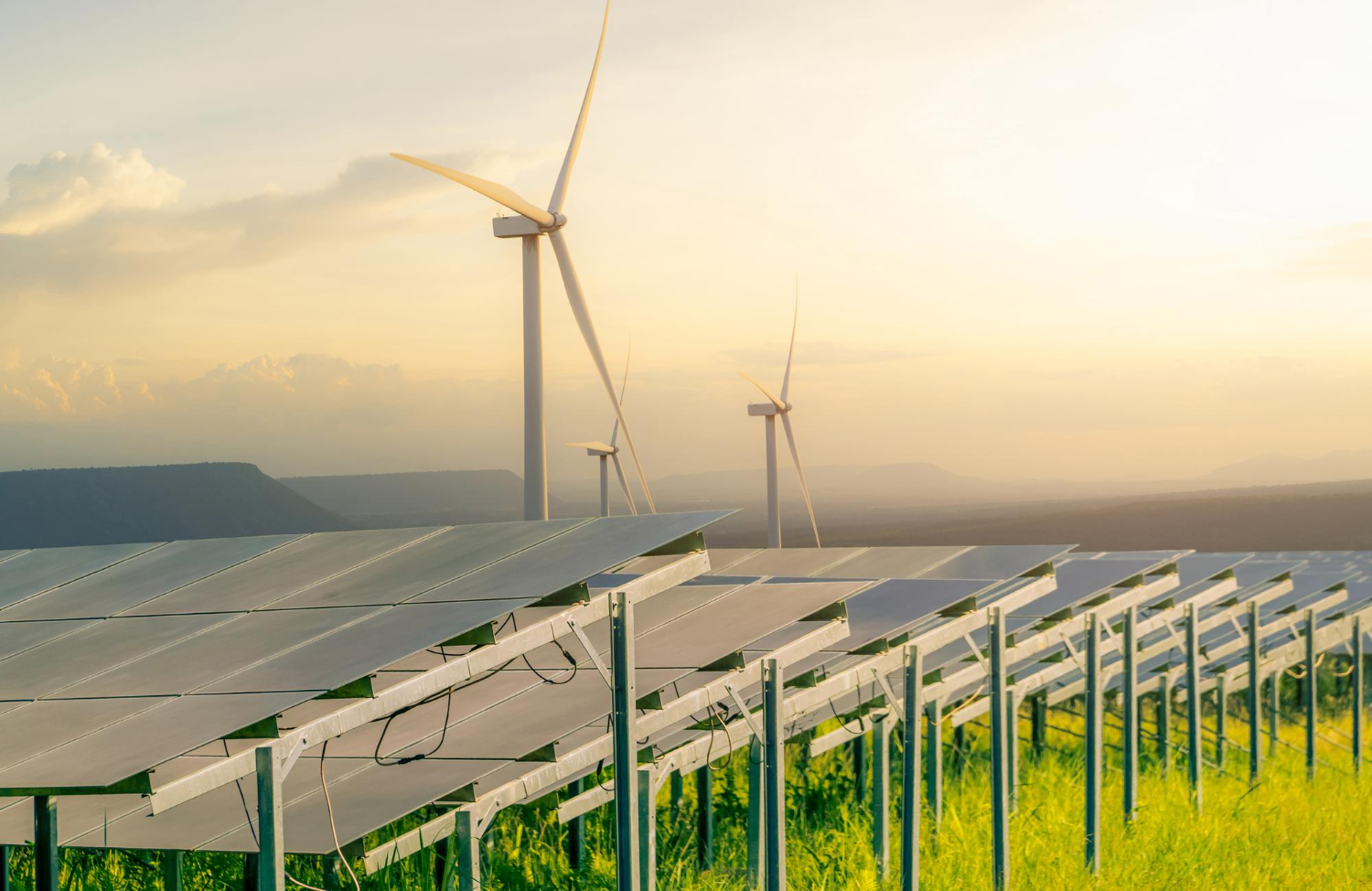
There is a quiet irony at the heart of the renewable energy transition: the two cleanest, most abundant power sources on the planet have spent most of their commercial lives working in separate lanes. Solar farms are built where the sun is strong; wind farms where the wind blows. Rarely do developers ask what happens when you put them in the same place, on the same grid, working as one system. Increasingly, the answer seems to be one of the most underrated ideas in clean energy.
Anyone who has watched weather patterns for a while has an intuitive sense of this: still, sunny afternoons often give way to breezier evenings, and cloudy days often bring more wind. This is not just a folk observation; it is a measurable, exploitable pattern. When solar output dips, wind often picks up the slack, and vice versa. A comprehensive global study analysing capacity factors across a decade of data found that medium-to-good seasonal and diurnal complementarity is the rule rather than the exception, with Europe, Southern India, Canada, and most of the United States standing out for especially high seasonal synergy (Nyenah et al., 2022). A meteorological assessment across Europe similarly found a weak hourly anticorrelation between wind and solar in many regions, strengthening in summer and over longer time windows (Miglietta et al., 2017). In Brazil, the effect is even more dramatic, with the northeast showing the greatest complementarity potential, thanks to high nighttime wind speeds that directly offset the solar system’s daytime-only nature (Couto & Estanqueiro, 2020).
This is not a geographical coincidence; it reflects genuine atmospheric physics. Solar heating drives daytime temperature differentials that fuel afternoon winds, while at night, as the ground cools, different pressure gradients take over. Nature seems to have designed this pairing for teamwork.
For grid operators, the appeal is practical. Standalone solar and wind plants are both intermittent, but in different ways, creating sudden ramps and necessitating expensive backup capacity. The National Laboratory of the Rockies (NREL) explains that combining resources whose generation profiles are anticorrelated spreads output more evenly across time, and that hybrid plants built from complementary resources achieve higher capacity factors, less curtailment, and lower costs thanks to smaller interconnection and storage requirements (National Renewable Energy Laboratory [NREL], 2023).
This also has a direct dollar value, since battery storage is one of the most expensive components of a renewable system. NREL researchers modelling high-renewable U.S. grid scenarios found that the benefit of storage in reducing curtailment falls off sharply beyond about 8 hours of duration (Denholm & Mai, 2017), meaning that any strategy that shortens generation gaps, like hybridisation, lessens the need for expensive long-duration capacity. Industry analysis confirms this from the plant owner’s perspective: a wind-solar hybrid requires less storage to stabilise the grid than a standalone facility, and wind’s cooling effect on solar panels can also slow their degradation over time (Navitas Solar, 2024).
There is also a simpler, almost mundane advantage: shared infrastructure. A wind turbine’s footprint is small relative to its blades’ swept area, leaving plenty of open land for solar panels beneath and around it. Both technologies can share access roads, substations, and the same transmission line back to the grid, which otherwise sits idle whenever a single-technology plant is not generating. A case study from Indian developer CleanMax illustrates the scale of the gap: a typical standalone wind farm in India runs at roughly 35% plant load factor and a standalone solar farm at roughly 17%, but co-locating and hybridising the two lifts the combined figure to around 52% (CleanMax, 2021).
The Economics: A Stronger Business Case
Put together, these effects add up to a stronger investment case. A techno-economic mapping of India’s renewable resources by NREL researchers identified locations where the levelized cost of energy for a hybrid plant undercuts that of standalone wind or solar, largely driven by transmission savings (Chernyakhovskiy et al., 2021, as cited in Pranav et al., 2025). Industry-wide reviews report that while standalone solar projects typically achieve a capacity utilisation factor of 20–25% and standalone wind projects 22–35%, co-located hybrids often achieve a blended capacity utilisation factor of 35% or higher (Pranav et al., 2025). The effect can be even greater when retrofitting existing sites: a study across India found that in seven of eight locations examined, adding a complementary resource to an existing plant could increase annual output by up to 400% (Jani et al., 2022).
Proof in the Field
Hybrid systems are not theoretical. India has emerged as one of the world’s most active testbeds for wind-solar hybrids, partly by policy design. As of late 2021, 3.75 GW of hybrid capacity had been granted in the country, with roughly 0.148 GW operational and another 1.7 GW in bidding (Kumar et al., 2024). India’s tenders require that either the solar or wind component make up at least 33% of a hybrid project’s capacity, ensuring genuine dual-technology builds (Kumar et al., 2024). Newer auction formats go further still, mandating capacity utilisation factors of up to 80% alongside guaranteed peak-hour power (Pranav et al., 2025). Brazil offers a complementary story, with its northeast one of the most naturally suited regions on Earth for this kind of hybridisation (Couto & Estanqueiro, 2020).
Policy and Climate Resilience
Complementarity benefits do not happen automatically just because two technologies exist in the same country — they happen when tenders and grid codes actively reward co-location. A review of Indian hybrid policy notes that shared data systems and a common point of interconnection improve cost efficiency, especially for higher-capacity projects (TÜV Rheinland, 2020). There is also a forward-looking argument: as weather patterns shift with the changing climate, relying on a single renewable resource becomes a riskier bet. A portfolio drawing on two physically distinct atmospheric processes is inherently better hedged against the risk of one underperforming in the future.
Conclusion
Wind and solar were never really in competition. The data increasingly shows they were made to work together, offsetting each other’s time gaps, sharing the infrastructure that connects them to the grid, and reducing the storage the system needs to stay reliable. For developers, that means better returns. For grid operators, a steadier resource. For policymakers, a clear signal to treat hybridisation not as a niche option, but as the standard for the next generation of renewable energy.
References
Chernyakhovskiy, I., Palchak, D., & Rose, A. (2021). Opportunities for hybrid wind and solar PV plants in India. National Renewable Energy Laboratory.
CleanMax. (2021, May 4). Wind solar hybrid project – Case study. https://www.cleanmax.com/case-studies/case-study-wind-solar-hybrid.php
Couto, A., & Estanqueiro, A. (2020). Exploring wind and solar PV generation complementarity to meet electricity demand. Energies, 13(16), 4132. https://doi.org/10.3390/en13164132
Denholm, P., & Mai, T. (2017). A new study indicates that short-term storage can reduce variable-generation curtailments. National Renewable Energy Laboratory. https://www.nrel.gov/manufacturing/news/program/2017/new-study-indicates-shorter-term-storage-can-reduce-variable-generation-curtailments
Jani, H. K., Kachhwaha, S. S., Nagababu, G., & Das, A. (2022). Hybrid wind–solar energy and resource simultaneity: An Indian case study for site selection and feasibility check. Energy Reports, 8, 593–598. https://doi.org/10.1016/j.egyr.2022.10.262
Kumar, C. R., et al. (2024). Advances and development of wind-solar hybrid renewable energy technologies for energy transition and sustainable future in India. https://www.researchgate.net/publication/367530866
Miglietta, M. M., Huld, T., & Monforti-Ferrario, F. (2017). Local complementarity of wind and solar energy resources over Europe: An assessment study from a meteorological perspective. Journal of Applied Meteorology and Climatology, 56(1), 217–234. https://doi.org/10.1175/JAMC-D-16-0031.1
National Renewable Energy Laboratory. (2023). Complementarity of renewable energy-based hybrid systems (DOE/GO-102023-5896). U.S. Department of Energy. https://docs.nrel.gov/docs/fy23osti/81901.pdf
Navitas Solar. (2024, May 22). Indian wind solar hybrid projects: Opportunities and challenges. https://navitassolar.in/wind-solar-hybrid-wsh-projects-in-india-opportunities-challenges/
Nyenah, E., Sterl, S., & Thiery, W. (2022). Pieces of a puzzle: Solar-wind power synergies on seasonal and diurnal timescales tend to be excellent worldwide. Environmental Research Communications, 4, 055011. https://iopscience.iop.org/article/10.1088/2515-7620/ac71fb
Pranav, N., Thanmayee, M. K., Champa, P. N., & Varshini, K. (2025). A review on integrating hybrid (wind & solar) energy systems in India. International Journal of Engineering Research & Technology, 14(12). https://www.ijert.org/a-review-on-integrating-hybrid-wind-solar-energy-systems-in-india
TÜV Rheinland. (2020, September 16). Grid connected wind solar hybrid power system in India. https://insights.tuv.com/blog/grid-connected-wind-solar-hybrid-power-system-in-india
