

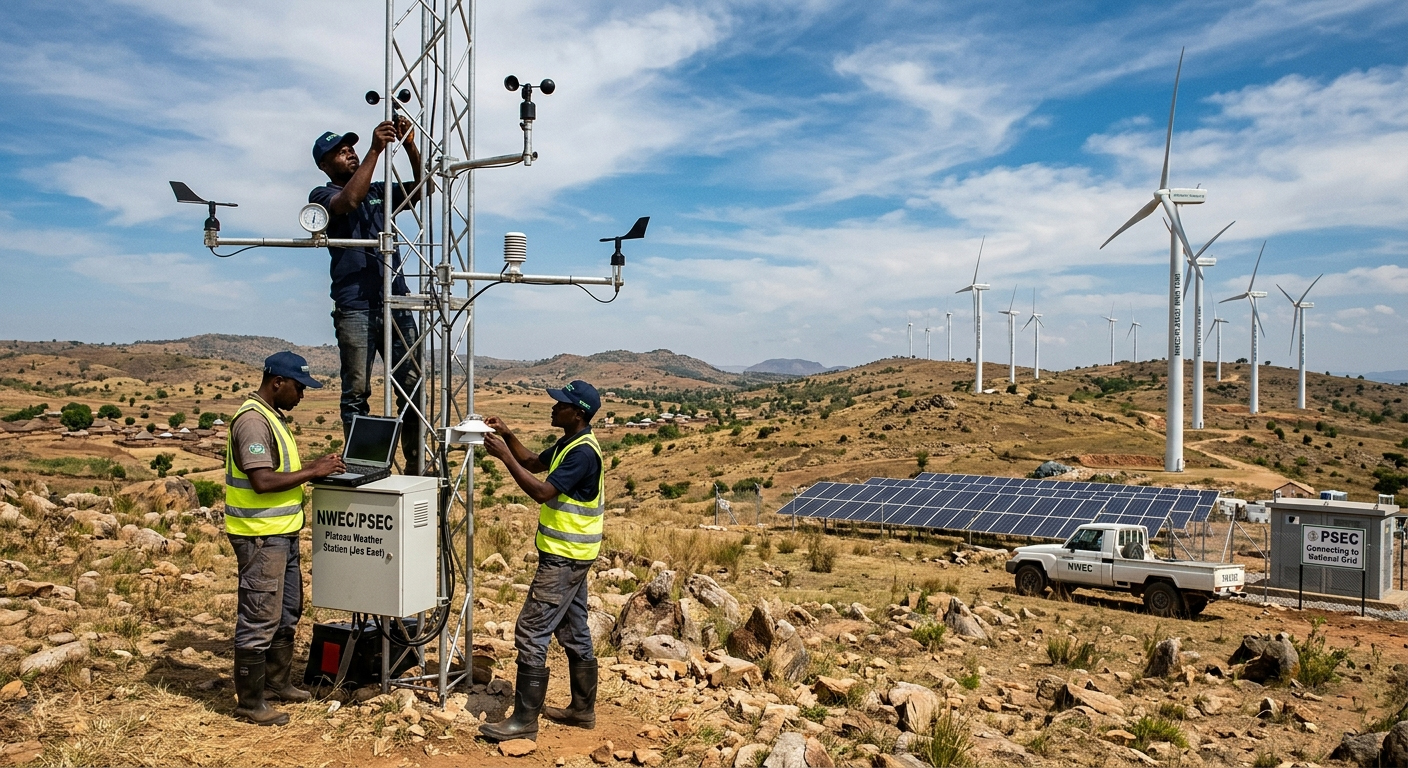
As Nigeria continues its journey toward a cleaner, more diversified energy future, conversations about renewable energy are becoming increasingly important. Solar farms, wind turbines, mini-grids, and hybrid energy systems are no longer distant concepts; they are now part of national conversations on energy security, industrial growth, and sustainable development.
However, before any renewable energy project can succeed, one thing must come first: accurate data.
Behind every successful wind farm or solar installation lies years of environmental measurements and resource assessment. Developers, investors, engineers, and policymakers all rely on accurate meteorological information to determine whether a project is technically viable, financially sustainable, and capable of producing electricity consistently over time (IRENA, 2025).
In simple terms, renewable energy projects do not begin with turbines or solar panels. They begin with measurements.
Why Wind Data Matters
Wind energy depends entirely on atmospheric behaviour. The amount of electricity a wind turbine can generate is directly influenced by wind speed, wind direction, turbulence intensity, seasonal variability, and atmospheric conditions. According to the International Renewable Energy Agency (IRENA), wind power output increases significantly with wind speed, meaning even small measurement differences can greatly affect project outcomes. (IRENA) This is why wind data collection is such a critical stage in renewable energy development.
Before investors commit millions of dollars to a wind energy project, they need answers to important questions:
- Is the wind resource strong enough to sustain electricity generation?
- How stable are the wind patterns throughout the year?
- What turbine technology is best suited for the location?
- How much electricity can realistically be generated?
- Will the project remain financially viable over time?
Without accurate data, these decisions become assumptions rather than evidence-based planning.
The World Bank’s Energy Sector Management Assistance Program (ESMAP) notes that renewable energy resource assessment and mapping are essential prerequisites for governments and investors to properly plan renewable energy infrastructure and attract investment into the sector (World Bank, 2020). (World Bank)
Globally, countries with strong renewable energy datasets tend to attract more private investment because developers and financial institutions trust the quality of available information. Reliable data reduces uncertainty, and reduced uncertainty lowers investment risk.
This is how measurements eventually become megawatts.
Weather Stations Do More Than Measure Wind
One of the most overlooked aspects of renewable energy measurement campaigns is that they provide benefits far beyond wind energy alone.
Modern weather stations collect multiple forms of environmental data simultaneously. In addition to wind speed and direction, they can measure: Solar radiation, Temperature, Relative humidity, Atmospheric pressure, Rainfall patterns, Air density and Climate variability indicators. This broader environmental data is becoming increasingly important as Nigeria seeks to strengthen both its renewable energy planning and climate resilience strategies.
For instance, solar radiation measurements collected alongside wind data can help identify regions with strong solar energy potential. Although Nigeria is widely known for its abundant sunlight, solar intensity still varies across regions and seasons. Ground-level measurements, therefore, provide more accurate insights than relying solely on satellite estimates.
According to IRENA’s renewable potential assessment initiative, resource mapping and environmental datasets are essential tools for policymakers, investors, and project developers seeking to identify viable renewable energy opportunities (IRENA, n.d.). (IRENA)
In practice, this means that one weather station can support multiple national objectives simultaneously: renewable energy development, Climate monitoring, Agricultural planning, Infrastructure resilience, Disaster preparedness, and scientific research.
As climate variability increasingly affects energy systems worldwide, integrating climate intelligence into energy planning is becoming increasingly important. The joint WMO–IRENA Renewable Energy Reports emphasise that climate-informed planning and forecasting are now essential for building reliable renewable energy systems (WMO & IRENA, 2026). (World Meteorological Organization)
Understanding Nigeria’s Weather Patterns Better
Nigeria’s climatic conditions vary significantly across different regions. Wind characteristics in Plateau State differ greatly from those in coastal areas, arid northern regions, or densely forested southern zones.
Yet, despite this diversity, Nigeria has historically faced limitations in the long-term, location-specific collection of renewable energy and meteorological data.
In many cases, developers rely heavily on satellite models or broad regional estimates when assessing renewable energy potential. While these tools are useful, studies show that coarse-resolution models often fail to fully capture local climatic conditions, underscoring the importance of ground-based measurements for accurate project development (Gruber et al., 2020).
This is where weather stations become invaluable.
Over time, continuous environmental measurements help reveal Seasonal wind trends, patterns in solar radiation intensity, temperature fluctuations, rainfall variability, climate-related risks, and extreme weather occurrences. These insights not only support renewable energy development but also improve national understanding of climate behaviour and weather systems. The World Meteorological Organization (WMO) has consistently highlighted the importance of long-term weather records in understanding climate variability and informing future planning decisions (WMO, 2025). (World Meteorological Organization)
NWEC’s Work in Plateau State
At the Nigeria Wind Energy Council (NWEC), the importance of accurate environmental data continues to shape ongoing renewable energy initiatives.
As part of efforts to strengthen Nigeria’s renewable energy data ecosystem, NWEC, in partnership with the Plateau State Energy Corporation (PSEC), deployed weather stations across four Local Government Areas in Plateau State: Jos East, Kanke, Langtang North and Shendam. These weather stations are designed to collect meteorological data to support renewable energy resource assessment and evidence-based planning.
Importantly, the initiative goes beyond measuring wind speed alone. The deployed stations also contribute to the collection of broader environmental variables, including solar radiation and atmospheric conditions that are critical for understanding renewable energy potential and weather behaviour across the region.
Plateau State’s elevated terrain and unique climatic conditions make it particularly important for assessing renewable energy resources. By gathering real-time, location-specific environmental data directly from these communities, NWEC is helping build the reliable evidence base required for future renewable energy investments and planning.
The initiative also reflects a broader national need: creating localised datasets that can inform policy decisions, attract investment, and support Nigeria’s long-term energy transition goals.
Building Nigeria’s Renewable Energy Future
As the world accelerates toward cleaner energy systems, data is becoming one of the most valuable resources in the energy sector.
Accurate wind and environmental measurements allow governments to plan more effectively, help investors make informed decisions, and support the development of projects that can deliver reliable electricity for decades.
For Nigeria, improving renewable energy data collection is not simply a technical exercise. It is a strategic investment in the country’s future.
Reliable environmental data can help: Unlock renewable energy financing, reduce project development risks, improve energy infrastructure planning, support hybrid energy systems, expand electricity access, and strengthen climate adaptation efforts.
Ultimately, the success of renewable energy depends on a precise understanding of the environment because before turbines spin, before solar panels generate electricity, and before renewable energy projects transform communities, the process always begins with measurements.
And with the right data, Nigeria can move confidently from measurements to megawatts.
References
Gruber, K., Regner, P., Wehrle, S., Zeyringer, M., & Schmidt, J. (2020). Towards a global dynamic wind atlas: A multi-country validation of wind power simulation from MERRA-2 and ERA-5 reanalyses bias-corrected with the Global Wind Atlas. arXiv.
International Renewable Energy Agency (IRENA). (2015). Wind Resource Measurement Guidelines for Islands.
International Renewable Energy Agency (IRENA). (2025). Wind Energy.
International Renewable Energy Agency (IRENA). (n.d.). Renewable Potential Assessment.
World Bank. (2020). ESMAP Renewable Energy Resource Assessment and Mapping Initiative.
World Meteorological Organization (WMO). (2025). World Weather Records (WWR).
World Meteorological Organization (WMO) & International Renewable Energy Agency (IRENA). (2026). 2024 Year in Review: Climate-driven Global Renewable Energy Resources and Energy Demand Review.
Author: Adedamola Adekoya
Policy, Research & Communications Analyst.
